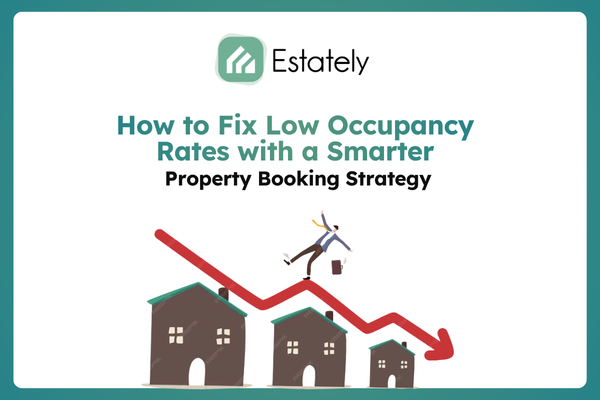
Low Occupancy Rates?
Fix Your Booking Strategy
Empty units aren't just a revenue problem — they're a signal that something in your booking strategy needs to change. Here's a systematic approach to diagnosing and fixing low occupancy.
📈 8 min read · Strategy & RevenueOccupancy is the clearest measure of how well your booking operation is working. High occupancy means your units are in demand, your pricing is competitive, and your booking process is converting inquiries into reservations. Low occupancy means at least one of those things is broken.
Before you can fix occupancy, you need to diagnose which part of the funnel is leaking. The three failure points below account for the vast majority of underperformance.
Demand Visibility Problem
Potential customers can't book what they can't find. If your availability isn't clearly visible and your booking process has friction, demand that exists never converts.
Pricing Mismatch
If rates are too high relative to demand in a given period, units sit empty. If they're too low, you fill up but leave margin on the table. Neither is optimal.
Conversion Failure
Interest without a fast, frictionless path to booking means high intent converts to nothing. Slow responses and complex processes kill occupancy before it starts.
The 5 Real Reasons Occupancy Is Low
Each of these is measurable. Each of these is fixable. Start with the one that resonates most — they don't have to be solved together.
Your Booking Process Has Too Many Steps
Every extra step between "I want to book" and "booking is confirmed" is an opportunity for the customer to abandon. If customers need to send an email, wait for a reply, fill out a form, and then wait for another confirmation — many will simply move on. The path to booking should be as short as possible.
Availability Isn't Visible to Potential Customers
If customers have to ask you whether a unit is available, you've already created friction. Real-time availability — visible at the point of inquiry — removes the question entirely and accelerates the decision to book.
You're Not Tracking Which Units Underperform
If you don't have unit-level occupancy data, you're treating all underperformance the same way. A conference room that never books on Fridays has a different problem than a private office that gets inquiries but doesn't convert them. Data separates the diagnosis.
No Strategy for Off-Peak Periods
Most properties have predictable slow periods. Without a proactive strategy — targeted short-term discounts, bundled offers, or minimum stay promotions — those periods simply become vacant inventory and lost revenue. Knowing your slow periods in advance gives you the window to act.
Cancelled Bookings Have No Recovery Process
When a booking is cancelled, that slot is a fresh revenue opportunity — but only if someone acts on it. In a manual system, cancelled slots often go unfilled because there's no mechanism to surface them as open opportunities or notify interested customers automatically.
Occupancy Benchmarks by Property Type
Understanding where you stand relative to healthy benchmarks is the first step to knowing how much ground to recover.
| Property Type | Healthy Occupancy | Concern Zone | Action Needed |
|---|---|---|---|
| Coworking Spaces | 70–85% | 50–69% | Below 50% |
| Meeting & Conference Rooms | 60–80% | 40–59% | Below 40% |
| Private Offices | 75–90% | 55–74% | Below 55% |
| Short-Term Rentals | 65–80% | 45–64% | Below 45% |
| Commercial Units | 80–95% | 60–79% | Below 60% |
5 Strategies to Lift Occupancy with Better Booking Management
These aren't marketing tactics. They're operational changes that directly affect how many of your units get filled and how quickly.
Make Availability Instantly Visible
Live availability calendars that update in real time remove the biggest conversion barrier: the "let me check and get back to you" response that kills bookings.
Confirm Instantly, Not Eventually
Automated booking confirmation means customers know their reservation is secured within seconds. This reduces anxiety and reduces the likelihood of them booking elsewhere while waiting.
Track Occupancy by Unit, Not Total
A 65% average can hide a unit sitting at 20%. Unit-level reporting exposes underperformers and tells you exactly where to focus pricing and marketing efforts.
Build an Off-Peak Pricing Strategy
Use historical booking data to identify predictable slow periods, then create pricing rules — discounts, short-stay bundles, or longer minimums with value-adds — that activate automatically in those windows.
Act on Cancellations Immediately
Every cancellation is a recovery opportunity. When your system reopens availability automatically and you have waitlist or follow-up logic in place, cancelled slots rarely stay empty for long.
Review Weekly, Not Monthly
Monthly reporting tells you what happened. Weekly reporting gives you time to do something about it. Build a weekly occupancy review cadence so adjustments happen in time to impact results.
The difference between a 55% occupancy rate and a 78% occupancy rate often isn't demand — it's how quickly and confidently your system converts interest into confirmed bookings.
Empty Units Are a
Solvable Problem
Estately gives you the booking infrastructure, real-time calendar management, and reporting tools to understand and improve occupancy — at every unit, across every property.